Download Ebook The Global Transformation of Time: 1870–1950, by Vanessa Ogle
From some problems that exist from the books, we always come to be curious of how you will get this book. However, if you feel that challenging, you could take it by following the link that is supplied in this web site. Discover also the various other listings of guides that can be owned and also reviewed. It will not limit you to just have this book. However, when The Global Transformation Of Time: 1870–1950, By Vanessa Ogle comes to be the first choice, just make it as genuine, as just what you actually want to seek for and get in.
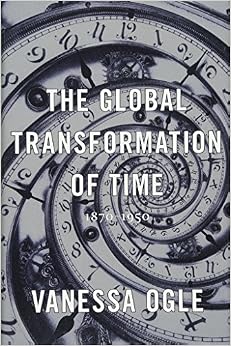
The Global Transformation of Time: 1870–1950, by Vanessa Ogle

Download Ebook The Global Transformation of Time: 1870–1950, by Vanessa Ogle
We always commit to keep as well as respect individuals needs of publications. Publications as a fantastic things to be resources in the world are constantly needed, almost everywhere as well as each time. When you have more sources to take, books still hold the large powers. One of the effective books that we will certainly proffer now is the The Global Transformation Of Time: 1870–1950, By Vanessa Ogle It is seemly a book that offers a different statement as others. When many people attempt to get this type of publication with that said intriguing topic, this publication comes disclosed for you.
This is not sort of usual book. It provides you remarkable material to acquire the ideas. Beside, the presence of this book will certainly lead you to constantly really feel much better. You could not need to create or invest more time to go; the The Global Transformation Of Time: 1870–1950, By Vanessa Ogle can be gotten from the soft file. Yeah, as this is an internet collection, you could locate lots of kinds and also categories of the books based upon the motifs that you really need.
Someone will always have factor when supplying sometimes. As right here, we likewise have several reasonable advantages to take from this publication. First, you can be among the hundreds people who read this The Global Transformation Of Time: 1870–1950, By Vanessa Ogle, from numerous areas. After that, you could get a very easy means to find, obtain, and also read this book; it exists in soft data based upon on-line system. So, you could review it in your gizmo in which it will certainly be constantly be with you.
By in this manner, you can be better to have spirit to review. The simple means to obtain, bring, and enjoy reading of this publication is additionally establishing when getting it in soft documents. By conserving in some gadgets, you are most likely having more than a publication. So, make certain that you download as well as delight in the The Global Transformation Of Time: 1870–1950, By Vanessa Ogle to review. The web link that we offer will aid you in dining the appropriate publication there.
Review
The powerful lesson of Ogle’s book is how the gradual global transformation of time over the course of the twentieth century came to suit many different parties, all of whom thought they had something to gain from new modes of integration and connectivity. The process we anachronistically call ‘globalization,’ Vanessa Ogle shows, was made up of forces that often used international means to solve national or parochial problems. (Thomas Meaney Times Literary Supplement)Ogle is more interested in the ways in which the concept of global time helped create what she calls a ‘global imagination,’ in which peoples and societies could be understood as parts of a single, developing world system. In this way, Ogle argues, the standardization of time reflected and reproduced the world’s European-led power hierarchies. International clocks and calendars united the world, but they also revealed and sometimes reinforced its inequities. (G. John Ikenberry Foreign Affairs)Today, we take our global system of timekeeping largely for granted… Yet in her imaginative and thought-provoking new book The Global Transformation of Time: 1870–1950, Vanessa Ogle reminds us that standardization and simultaneity had to be invented… Ogle’s formidable work contributes to a new history of political economy which takes seriously the ideas, values, and acts of violence behind the emergence of global capitalism. (Ian P. Beacock The Atlantic)How exactly horological chaos gave way to order is the subject of Ogle’s accessible and prodigiously researched book…Ogle has insightful things to say about many topics, from the role of cosmopolitan ports in disseminating new kinds of timepieces, to Islamic calendars, to the curiously moralizing tone of early discussions of using daylight savings schemes to prevent people from squandering precious sunshine hours. Perhaps her most important contribution is to show, via discussion of the various ways that power relations shaped debates relating to time, how foolish it is to view globalization, in any period, as a smooth, value-free process of flattening out. (Jeffrey Wasserstrom Financial Times)With impressive breadth, imagination, and originality, Ogle has produced an important and genuinely global history of time that reveals the rhythms, directions, unevenness, and contradictory consequences of what we now call globalization. (Geoff Eley, University of Michigan)Writing global history is still a high-stakes venture, and Ogle’s The Global Transformation of Time is an impressive testimony to the potential of the genre. We get a deep sense of the talk about time and calendars among transnational experts and politicians as well as the everyday intelligence that produced differentiated time regimes―times for travel, for work, for leisure, for religious practice or, as may be, for milking cows―across the globe in Berlin and Beirut, London and Bombay, and their rural hinterlands. Reading this book is a tremendous intellectual pleasure from beginning to end. (Michael Geyer, University of Chicago)Globalization is all the rage in the 21st century. What technology and cultural factors led to this shrinking world? One of the factors often overlooked, even taken for granted, is our system of uniform time…The progressives who advocated for uniform time found themselves dealing with nationalism, regionalism, and colonialism, as well as resistance from labor, religion, and other groups with a vested interest in the status quo. Ogle provides an intriguing glimpse into the machinations that led to the globalization of time. (T. Timmons Choice)
Read more
About the Author
Vanessa Ogle is Julie and Martin Franklin Assistant Professor of History at the University of Pennsylvania.
Read more
Product details
Hardcover: 288 pages
Publisher: Harvard University Press (October 12, 2015)
Language: English
ISBN-10: 0674286146
ISBN-13: 978-0674286146
Product Dimensions:
6.2 x 1 x 9.2 inches
Shipping Weight: 1.6 pounds (View shipping rates and policies)
Average Customer Review:
5.0 out of 5 stars
4 customer reviews
Amazon Best Sellers Rank:
#895,432 in Books (See Top 100 in Books)
You can look at your smartphone or computer and tell the the time to such an exactitude that only scientists in obscure ivory towers need anything more accurate. And, other than the differences in time zones, everyone else in the world can do the same and get the same reading. That there is an agreed-upon world standard for such a thing might be a cause for optimism, especially since a century ago there was lots of worldwide disagreement about marking time. The late nineteenth and early twentieth centuries were the period when people started discussing worldwide time and coming to agreements about it. It wasn’t always a coldly scientific endeavor, with power plays and nationalism often more important than objectivity, but how we came to the current standard is the story in _The Global Transformation of Time 1870 - 1950_ (Harvard University Press) by historian Vanessa Ogle. Ogle tells a careful and well-researched story of how horological chaos was transformed into our current and rather sensible system, and concentrates less on the world conferences that agreed on, say, dividing the longitude line at Greenwich for a standard, than the social, economic, and political forces that pushed for change.Before the time covered in Ogle’s book, there was little need to try to synchronize clocks in different locales. It was train travel that showed the difficulties of all those different village times as people started moving long distances at fast speeds. Different railways kept time differently; in 1875, there were six different railway times being used just within the city of St. Louis. In 1883, the railroads decreed a Standard Railway Time, four hour-wide zones across America. It wasn’t until the next year that there was held in Washington, DC, an international Prime Meridian Conference, which agreed to use the longitude line running through Greenwich as the starting point for a system of 24 hour zones around the world. One of the ways that universal time was spread was by colonial governments imposing it upon their colonies. “Universalism was never neutral,†writes Ogle. “The main proselytizers of European time appear to have been missionaries and employers of indigenous laborers.†Tribes that had done quite well following the Sun, Moon, and stars had to conform to work hours, and so they had to conform to European time. It was but one aspect of impositions put upon natives, along with rules about clothes, housing, and morals, and as such was an extension of power. Reforming the world time eventually got done, but one of the surprises in Ogle’s book is that calendar reform was avidly proposed, although it didn’t get anywhere by comparison to clock reform. In the early 1900s, businessmen realized that to compare month by month statistics, it would be dandy to have evenly spaced months, thirteen of them, all of which started on a Monday, lasted for four weeks, and ended on a Sunday. Then there could be one day left over each year, which would be independent of in-week categorization. There were different means of making this happen, and vehement arguments between the proposers of the different schemes, but unifying calendars was different from unifying clocks. The big difference was that there was negligible resistance to clock reform from religious groups, but such groups did not like the idea of any calendar change, however logical: “Religious authorities successfully alerted public opinion to the religious objections to the project; their protests made national governments reluctant to interfere with religious sensitivities encapsulated in calendars.â€Ogle’s book presents the decades under discussion as a time of vast changes in movement and communication, and the resultant globalization is analogous to many of the changes we are undergoing in our own time. There is a theme here that is quite familiar, that of the sometimes contrary efforts of nationalization and globalization. The changes in designating time were messy and power-driven, but it is at end, however, a hopeful story. Time is vitally important to all of us, and it must mean something good that America, North Korea, Iran, and China, even with their differences and antagonisms, all keep time to the same standard.
Great book
Today we assume a shared global clock. Although we have time zones, I can establish with confidence what time it is in Paris or Tokyo. The process of standardising time keeping was not simple, however. Vanessa Ogle shows us how this process unfolded over decades of technological advance and political adjustment. Highly recommended!!
Terrific read about the origins of how we think and measure time around the world.
The Global Transformation of Time: 1870–1950, by Vanessa Ogle PDF
The Global Transformation of Time: 1870–1950, by Vanessa Ogle EPub
The Global Transformation of Time: 1870–1950, by Vanessa Ogle Doc
The Global Transformation of Time: 1870–1950, by Vanessa Ogle iBooks
The Global Transformation of Time: 1870–1950, by Vanessa Ogle rtf
The Global Transformation of Time: 1870–1950, by Vanessa Ogle Mobipocket
The Global Transformation of Time: 1870–1950, by Vanessa Ogle Kindle

0 komentar:
Posting Komentar