Free PDF Believe Me: The Evangelical Road to Donald Trump, by John Fea
Being a far better individual in some cases likely is difficult to do. Additionally, altering the old habit with the new behavior is hard. Actually, you could not need to change instantly the old habit to chatting. Hanging around, or juts gossiping. You will need detailed action. Additionally, the way you will certainly change your habit is by the reading practice. It will make so challenging obstacle to settle.
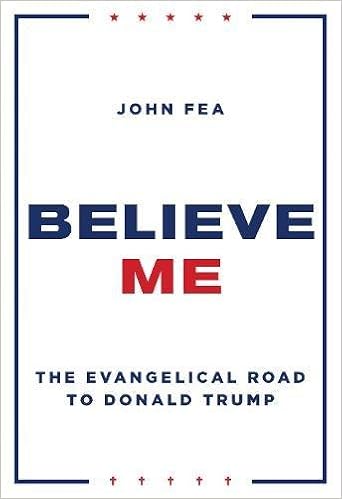
Believe Me: The Evangelical Road to Donald Trump, by John Fea

Free PDF Believe Me: The Evangelical Road to Donald Trump, by John Fea
Remarkable item is now offered below. The book entitled Believe Me: The Evangelical Road To Donald Trump, By John Fea is provided in this internet site as one of the most recent upgraded to offer. Yeah, this is one of recommended books that now many individuals search for guide. You may turn into one of those that are extremely fortunate today. You locate this site that will supply you the best recommendation of this book.
This book is one recommended book that can heal and deal with the time you have. Spare time is the best time to read a book. When there are no friends to talk with, this is better to utilize that time for reading. If you are being in the long waiting lists, this is also the perfect time to read or even being on an enjoyable trip. Believe Me: The Evangelical Road To Donald Trump, By John Fea can be a good friend; of course this simple book will perform as good as you think about.
And also why this book ends up being so preferred is that the here and now book comes from the prominent author on the planet. Many people admire the compositions regarding everything. The topic to discus and give is additionally much related to the life. So, you can be part of their mind and assumed that think about this amazing publication. To stimulate exactly what is told by Believe Me: The Evangelical Road To Donald Trump, By John Fea, you could begin to review it now.
After getting this publication, it will certainly be better for you to read it immediately. This book will connect the explanation and also factors of why this publication is most wanted. It will certainly be the methods you gain the brand-new capability and skills to be much better. Of course it will assist you to face the troubles of deadline jobs. Believe Me: The Evangelical Road To Donald Trump, By John Fea is really considerable to do and obtain, so exactly what kind of book material that you require currently? Discover them in the lists of this internet site.
Review
Mark Noll — author of The Scandal of the Evangelical Mind “John Fea’s timely and sobering book shows convincingly how legitimate concerns from white evangelical Protestants about a rapidly secularizing American culture metastasized into a fear-driven brew of half-truths, fanciful nostalgia, misplaced Christian nationalism, ethical hypocrisy, and political naiveté—precisely, that is, the mix that led so many white evangelicals not only to cast their votes for Donald Trump but also to regard him as a literal godsend.”Jana Riess — senior columnist for Religion News Service “It would be enough for John Fea to marshal his considerable prowess as a historian in proving how evangelicals have been propelled by fear, nostalgia, and the pursuit of power, as he does so compellingly in this book. But he also speaks here as a theologian and an evangelical himself, eloquently pointing toward a better gospel way. This is a call to action for evangelicals to move beyond the politics of fear to become a ‘faithful presence’ in a changing world.”Michael Wear — author of Reclaiming Hope: Lessons Learned in the Obama White House about the Future of Faith in America “In Believe Me John Fea takes evangelicalism seriously, treating it with the honest respect it deserves. He also manages to help us understand American politics in a much clearer way. I highly recommend this book to all who remain confounded by the state of faith and politics today.”Richard Mouw — author of Uncommon Decency: Christian Civility in an Uncivil World “While the significant support for Donald Trump by white evangelicals has been the stuff of headlines, there has been little serious probing of the deeper factors at work. John Fea here gives us what we need, with his insightful tracing of the theological-spiritual road that has brought us to this point. A wise and important book!”George Marsden — author of Religion and American Culture: A Brief History and Jonathan Edwards: A Life “For those who think the embrace of Trump by the ‘court evangelicals’ might be an example of yielding to the political temptation that Jesus resisted (Matt. 4:8–10), this is the book to read. Noted evangelical historian John Fea provides a thoughtful and engaging account and critique of how this unlikely alliance came to be.”Publishers Weekly (STARRED review) "Clear, concise, and convincing. . . . Fea uses his training as a historian to trace a chronology of the evangelical attraction to political power . . . and offers an alternative way (relying on hope and humility) for evangelical leaders to think about their relation to power."Foreword Reviews "Enlightening. . . . Meticulously researched and grounded in historical and theological contexts. . . . An important book for anyone, Christian or otherwise, who wishes to understand the 2016 election and who believes that we can do better."Salon “Extremely compelling.”
Read more
About the Author
John Fea is professor of American history at Messiah College in Mechanicsburg, Pennsylvania. His previous books include Was America Founded as a Christian Nation? A Historical Introduction, and he blogs regularly at The Way of Improvement Leads Home.
Read more
Product details
Hardcover: 248 pages
Publisher: Eerdmans; 1st Edition edition (June 28, 2018)
Language: English
ISBN-10: 0802876412
ISBN-13: 978-0802876416
Product Dimensions:
5.4 x 1 x 8.6 inches
Shipping Weight: 15.8 ounces (View shipping rates and policies)
Average Customer Review:
4.3 out of 5 stars
39 customer reviews
Amazon Best Sellers Rank:
#92,168 in Books (See Top 100 in Books)
I had seen John Fea's book, Believe Me: The Evangelical Road to Donald Trump (2018), featured on Eerdman's Facebook and Twitter feeds. I had never heard of him, but there was enough present in those short social media posts to intrigue me. Fea is an evangelical and chair of the history department at Messiah College in Pennsylvania, a historian who writes about "the intersection of American history, religion, politics, and academic life" (from his blog), no doubt appropriate preparation for writing a book of this sort.In Believe Me, Fea explores Donald Trump's popularity among American evangelicals--81% of them anyway. Along the way, he addresses the inconsistencies that many conservative religious leaders have demonstrated over time in their responses to different presidents, Clinton and Trump, for example, giving an unlimited pass to one while wanting to burn the other at the stake. Fea shared this example from a 1998 letter from James Dobson (a Trump supporter) questioning Clinton's morality: "As it turns out character DOES matter. You can't run a family, let alone a country, without it. How foolish to believe that a person who lacks honesty and moral integrity is qualified to lead a nation and the world! Nevertheless, our people continue to say that the President is doing a good job even if they don't respect him personally. Those two positions are fundamentally incompatible. In the book of James, the question is posed 'Can both fresh water and salt water flow from the same spring?' (James 3:11, NIVOpen in Logos Bible Software (if available)). The answer is no." In my opinion, those who fail to see the hypocrisy in this statement are blind.When Fea wrote of "the evangelical politics of fear," I resonated with the phrase. I think he is right when he suggests that fear drives many of the political viewpoints and voting practices among evangelicals. We place our hope not in God, the All-Sovereign, but in compromised earthly powers, especially those who tell us what to be afraid of and how they are the only ones who can fix it. The fear-mongering is reminiscent of Richard Dreyfuss's Senator Rumson in 1995's The American President. I was grateful that Fea is a historian; he was able to trace the roots of these fears to the 17th century up into the 21st century, with particular attention to the civil rights movement.His thoughts on Trump's slogan, "Make America Great Again," were also beneficial. He commented that as a historian, he was less interested in the definition of great than what Trump means by the word again. To what era is Trump referring? And from whose perspective? It remains nebulous. Fea rightly draws the distinction between history and nostalgia, noting that "nostalgia is closely related to fear." Fea writes, "Sometimes evangelicals will seek refuge from change in a Christian past that never existed in the first place. At other times they will try to travel back to a Christian past that did exist--but, like the present, was compromised by sin."In his conclusion, Fea calls evangelicals to three things: hope, not fear; humilty, not power; and history, not nostaligia.I found Believe Me to be an insightful, timely book and I cannot recommend it highly enough. Unfortunately, I suspect most of the 81% will not even consider reading it; it's something that Trump would quickly dismiss as "fake news." As Americans, we tend to prefer political propaganda propagated by Twitter, Facebook, and our preferred news networks than actually digging in, with humility, to consider what might be true. As Christians, whose primary citizenship is in an eternal kingdom, we cannot afford to do this any longer.I cannot think of a better way to conclude this book than with the quote that first intrigued me: "The Court Evangelicals have decided that what Donald Trump can give them is more valuable than the damage their Christian witness will suffer because of their association with the president."This is a really important book. Believe me.
Evangelical Christians who seriously pursue a biblical outlook will find wisdom nuggets in Messiah College history professor John Fea’s analysis of why 80% of 2016 voters who self-identified as evangelical, pulled the lever for the winner of the 2016 U.S. Presidential election. Much of this can be gleaned from Professor Fea’s powerful, well-written conclusion at the book’s end. The rest of the book is worth a read, but be prepared to wince at some of Fea’s extrapolations as he uses history to make his case that white evangelicals have categorically always been, and still are, deeply complicit in national sins such as racism and xenophobia.It’s tough to argue against Fea’s criticisms, especially if “evangelical†is taken to broadly include anyone who claims the label. And, unfortunately, that’s the same broad definition used by U.S. media. Fea does rightly acknowledge that this definition swells “evangelical†ranks to include the hordes of people who identify themselves as evangelical, without knowing or having experienced what the label even means. But a true evangelical, whose life has been changed by the reality of the living Jesus Christ, may bristle at this book for two reasons: 1) some of Fea’s characterizations and conclusions don’t fit true evangelical Christians, and 2) some of them do – and boy, does that hurt.Fea makes some powerful statements that ring true. He recalls Cal Thomas and Ed Dobson’s revelations in “Blinded by Might†(published in 2000) of their own hard-learned lessons about the folly of reliance upon “the right politicians†to win the “culture wars.†In fact, Fea’s work might be viewed as an update on Thomas and Dobson’s thesis in light of the 2016 election. Fea also gives us mostly-accurate historical background regarding evangelical Christian involvement in U.S. politics dating to colonial times. But parse facts from opinions carefully; Fea is often overly zealous in leading us into his generalized condemnations of evangelical Christian involvement in U.S. politics, and beware of a few key mis-statements he makes regarding the true intentions of the Founding Fathers.For example, Fea provides this un-footnoted observation as though it is fact: “Thomas Jefferson and James Madison, for example, were strong advocates for the complete separation of church and state.†This is an opinion at best. It would not withstand cross-examination by other historians such as American University’s Dr. Daniel Dreisbach, who in “Thomas Jefferson and the Wall of Separation between Church and State†(2002) presents careful research of Jefferson’s 1802 letter to the Danbury Baptists and of Jefferson’s other writings, speeches and voting record in the Virginia Assembly before his presidency. Dreisbach shows us that Jefferson viewed church and state as separate partners who conversed and cooperated over a fence as neighbors seeking the same common good. Fea’s mischaracterization of Jeffersonian thought is truly regrettable, especially for a learned historian who identifies himself as an evangelical.Fea carefully constructs a case that the U.S.’s 45th president used phrases such as “make America great again†and “I’m the law and order candidate†to signal Caucasian voters who view their race as superior to others, that he’s their man. He makes this case well; this conclusion by itself is believable. But he extrapolates too much, leading his readers to his own apparent conclusion that our current head of state is himself a white supremacist. Inflammatory? Manipulative? Clumsy, as evidenced by his completely blown opportunity to come out against hate groups in the wake of the Charlottesville violence? Absolutely! A more rotten performance among any U.S. president ever is hard to find. But truly a racist at heart? Perhaps naively, or just slower to judge, I want more freedom to wrestle with that than Fea will give me. Character assassination is a hard business, and Fea should have avoided going there.On the other hand, Fea’s applications of Scripture in his appeals for Christians to reconsider their over-reliance on politics to renew the culture, are as solid as anything you might get from the very best conservative (theologically, not politically) preachers that 2 millennia of Christianity has produced. That reality, plus the many truly insightful (if sometimes overly generalized, overly hyped) criticisms of how U.S. Christians have wrongly looked for their savior to rise up from the political system, makes this book an important read.
This was a book I was looking forward to for months. I follow John Fea on Twitter and read his blog. His perspective as an evangelical AND historian is one that gives me hope as an evangelical who is tempted to chuck the term "evangelical" altogether.Fea gives a very fast sketch of the politics of fear, along with the theology of fear, that has formed the evangelical movement and brings us to WHY 81 percent of white evangelicals voted for Trump in 2016.But Fea also offers some ideas for a way forward. Things to DISCUSS. (It's hopeful that discussion could ensue, though doubtful.) We need to move from fear to hope, from power grabbing to humility, and from nostalgia to a true sense of history.These past two years have left me with a bad taste in my mouth over what has happened to the American conservative church. Fea sets some context for us and tries to wake us up to some harsh realities.This is good analysis and then a prescription for a possible way forward... believe me.
Believe Me: The Evangelical Road to Donald Trump, by John Fea PDF
Believe Me: The Evangelical Road to Donald Trump, by John Fea EPub
Believe Me: The Evangelical Road to Donald Trump, by John Fea Doc
Believe Me: The Evangelical Road to Donald Trump, by John Fea iBooks
Believe Me: The Evangelical Road to Donald Trump, by John Fea rtf
Believe Me: The Evangelical Road to Donald Trump, by John Fea Mobipocket
Believe Me: The Evangelical Road to Donald Trump, by John Fea Kindle

0 komentar:
Posting Komentar